
I prefer water at room temperature. Not for alleged health reasons — it’s just how I like it. It is my second favorite way to drink water.
My favorite way to drink water is hot and passed through ground coffee beans.
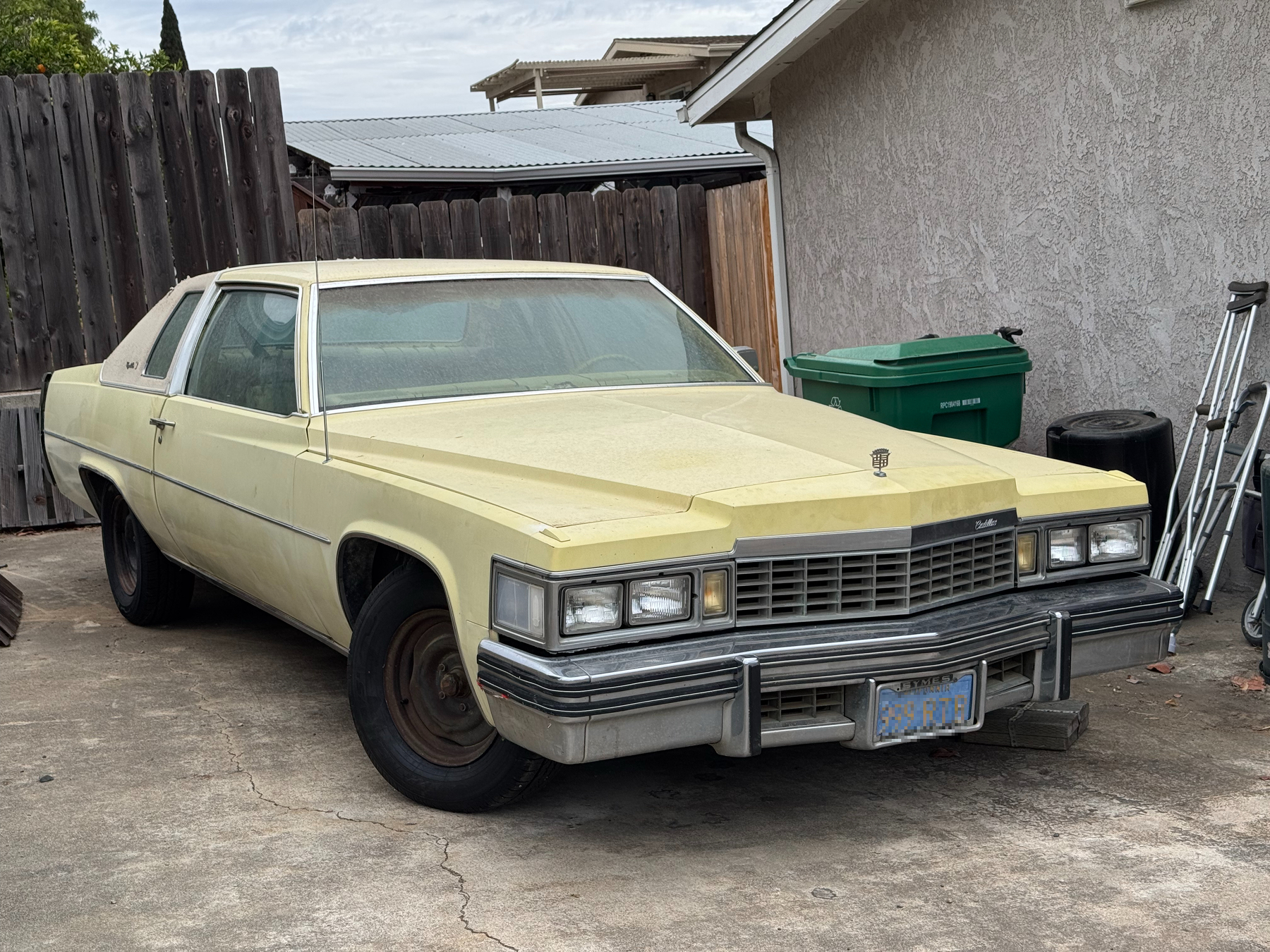
Here’s something I saw while out walking. I was instantly transported into an episode of The Rockford Files.
Siri identifies this is a 1975 or 76 Cadillac Coupe de Ville, based on the rectangular quad headlights, grille pattern and overall body style and paint. “The 1975 and 1976 Cadillac Coupe DeVille models were among the last of the truly full-sized American luxury coupes before Cadillac began downsizing its fleet in 1977.”
Neagley is a Lifetime miniseries if a Lifetime miniseries had a body count In the middle double digits.

Neagley is the heartwarming story of a psychologically damaged young woman who starts on the path to healing with the help of her loving father, friends and a great quantity of guns and explosives. It’s a spinoff of Reacher. It’s excellent, violent fun.
🦍 Mitchellaneous #195: Memes and other found media
Three dog house
While walking the dog I passed a neighbor’s house with three very loud and energetic dogs. I almost never see any of these dogs, because they are in a fenced backyard, and I usually don’t hear all three at once, but the full orchestra was out then two barking loudly in different keys and tempos and one heartily going BAROO BAROO BAROO. It was like a modern jazz concert.
I stopped to record it and an older man came out of the house across the street from the Three Dog House. He was behind me. “I’m enjoying the music,” I said, and then I thought about hearing that every day. “Probably you don’t enjoy it.”
Because I was interrupted, I did not record the concert.
The man looked at Minnie and exclaimed, “The cone of shame!” Yes, Minnie is still wearing the cone. It’s been a month. We have an appointment at an eye specialist and are planning to switch vets.
A few minutes later I passed a parked car with a license plate frame that read something like, “CALIFORNIA — WHERE AMERICA’S DAY STARTS.” At least I think that’s what it said. But that does not make sense. As a longtime tech trade journalist, I am aware in my bones that the rest of America wakes up well before California does; when I hit my desk on a workday morning my Teams messages and emails are already full.
That sent me a down an Internet rabbit hole to find out where America’s day REALLY starts — in other words, what’s the furthest point east in either the continental US or territories. There are two possible answers, one of them a technicality.
The common-sense answer is a point in the U.S. Virgin Islands. I always forget the U.S. Virgin Islands exists.
The other answer, which will be great to know for a pub trivia quiz: A point on the Aleutian Islands of Alaska, which goes so far west that it crosses the 180th Meridian and becomes east.
I did not research this point, but I expect that this means the point in the US that is furthest west and the point that is furthest east are a single footstep apart from each other.
Wikipedia’s Pyrrhic Victory A “city built by Asperger’s”: Julian Lucas’s in-depth review of the book “The Last Best Place on the Internet: A Human History of Wikipedia.” (The New Yorker)
r/opensource just banned AI, non-English speakers, and more (The Verge / Terrence O’Brien)
Do they simply hate AI? Or are they overwhelmed by the flood of AI slop?
How important is this subreddit in the broader open source community?
Banning non-English speakers makes this subreddit seem unimportant and parochial.
We should not be asking whether code — or any creative work — is generated by AI. We should instead ask whether it’s good.